“Can you build a 2-hour e-learning course on giving feedback?”
Short answer: no — and the analysis shows why. This is the full case study of what the analysis found instead.
Simulated case. Brightline Health Services is a fictional organization and every artifact here — intake, interviews, survey data, documents — was constructed for portfolio purposes to demonstrate a complete performance consulting engagement. See Attribution.
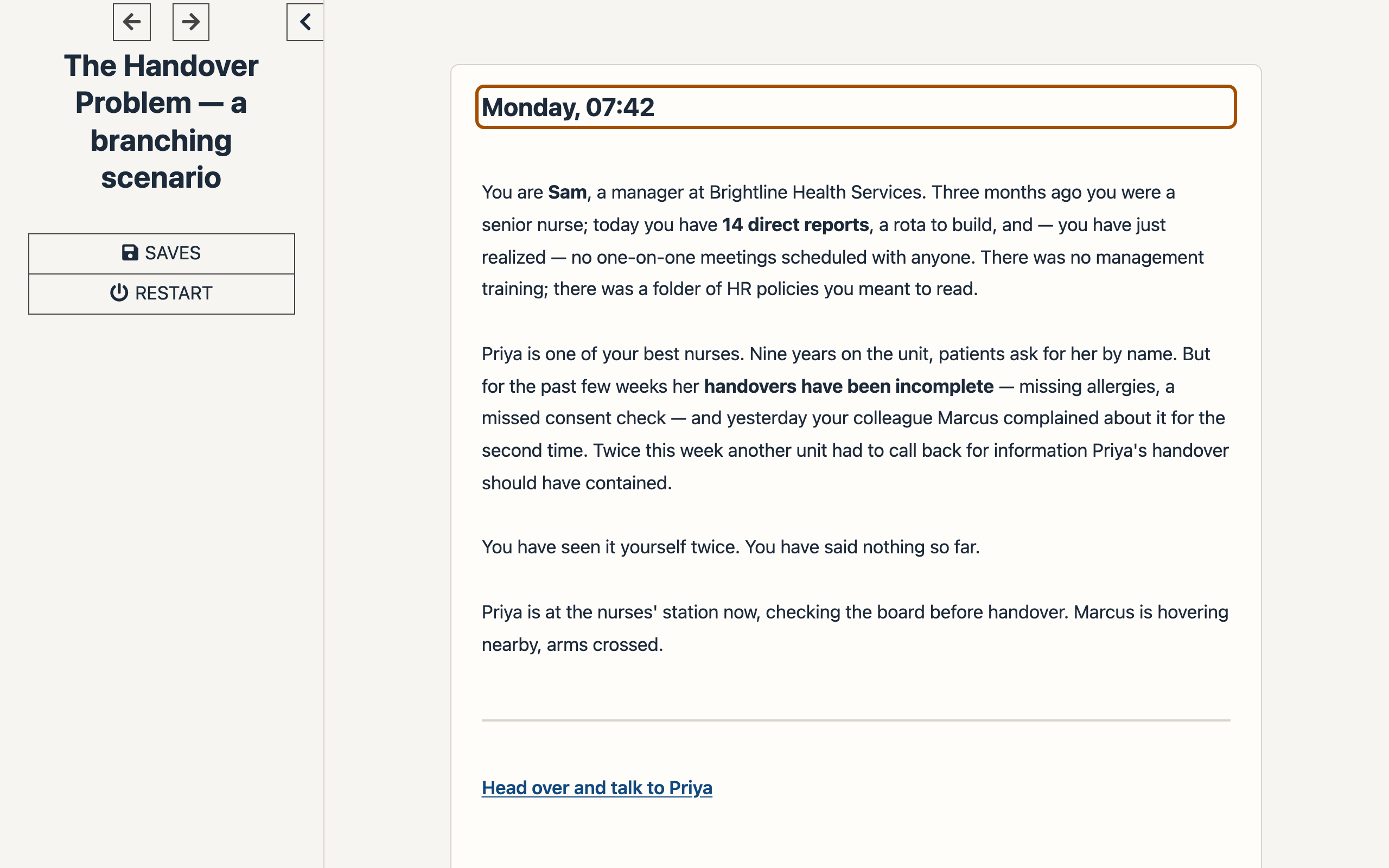
Play the branching scenario — the 15-minute practice activity at the heart of the recommended blend.
The request, verbatim
“Our engagement survey says employees don’t get useful feedback. Can you build a 2-hour e-learning course on giving feedback for all managers? We need it live next quarter.” — the (fictional) HR Director, completed intake form
The familiar move is to say yes and build the course. The consulting move is to ask what the survey actually shows before designing anything. The intake form captures the request in the requester’s own words and starts the reframing: which business result would move if managers gave better feedback? Answer: 90-day new-hire turnover, 22% (target 15%).
Discovery: the request complicates itself
Two weeks of interviews (3 managers, 2 staff, 1 HR), a 200-person pulse survey across all 12 clinics, and a document review (review form, one-on-one policy, org chart, scorecards). The messy details mattered:
- An experienced manager insists he gives feedback “constantly” — his team’s usefulness scores are among the worst in the company.
- HR has a one-on-one policy; it says meetings are “encouraged”, defines nothing, and tracks nothing.
- One clinic (Cedar Point) meets constantly and scores worst of all — meetings are not the same as feedback.
The twist: it’s mostly not a training problem
Run the evidence through Gilbert’s Behavior Engineering Model and the Mager & Pipe flow and four causes emerge — only one of which training can fix:
- Environment: one-on-ones aren’t scheduled; managers have 12–18 direct reports; no template, no rostered time.
- Process: the annual review is the only formal feedback point, and the form only asks for ratings.
- Skill: some managers (concentrated in the newest cohort) avoid hard conversations and can’t structure feedback — the narrow, real training need.
- Motivation: scorecards pay for throughput only; team development weighs 0%.
The killer number: feedback usefulness differs by 1.5 points between staff with and without regular one-on-ones — but by only 0.3 points across manager tenure. “Train the new managers” would miss most of the problem. Is it training? gives the two-minute defense.
The solution: a blend, and a list of things that won’t be built
The action map works backwards from the turnover goal to observable manager behaviors, and each behavior gets the cheapest intervention that works:
- Non-training: a fortnightly one-on-one standard + template, a review-form change, and a span-of-control review flagged to leadership
- Performance support: the “Feedback in 5 minutes” job aid (HTML + tagged PDF)
- Practice: a 15-minute branching scenario — Sam, Priya, three decisions, three endings, consequences instead of “Correct!”
- Reinforcement: a 30-day practice challenge with peer check-ins
- Measurement: a plan with leading and lagging indicators and a staggered-rollout isolation design
Equally important: what we won’t build — the 2-hour course, the quiz, the personality module, the offsite, the LMS packaging — and why. The stakeholder proposal makes the case in two pages with a cost comparison.
Measurement, and the honesty section
The baseline dashboard shows where Brightline starts (31% cadence, 2.4/5 pulse, 22% turnover). The usability test report documents what was actually tested: automated scripted tests and audits, a fresh-context agent review, and an agent-simulated learner run and review panel performed by one AI model (see evaluation/METHODS.md). It also states what no evidence here can show: real learner experience and learning gains.
Every dataset, interview and document in this case study is simulated and labeled as such. That’s not a disclaimer to scroll past — it’s the scope of the claim.
Start anywhere
| If you want to see… | Go to |
|---|---|
| The playable artifact | The Handover Problem (scenario) |
| The consulting judgment | What we won’t build · Proposal |
| The analysis spine | Root-cause analysis (BEM) · Is it training? |
| The evidence craft | Survey analysis · Generation method |
| The measurement thinking | Measurement plan |
| Reusable templates | Intake form · Interview guide |