Coaching cycle
Every 2–3 weeks per tutor · 30-minute observation + 15-minute debrief · One strength, one focus move, every cycle
The cycle
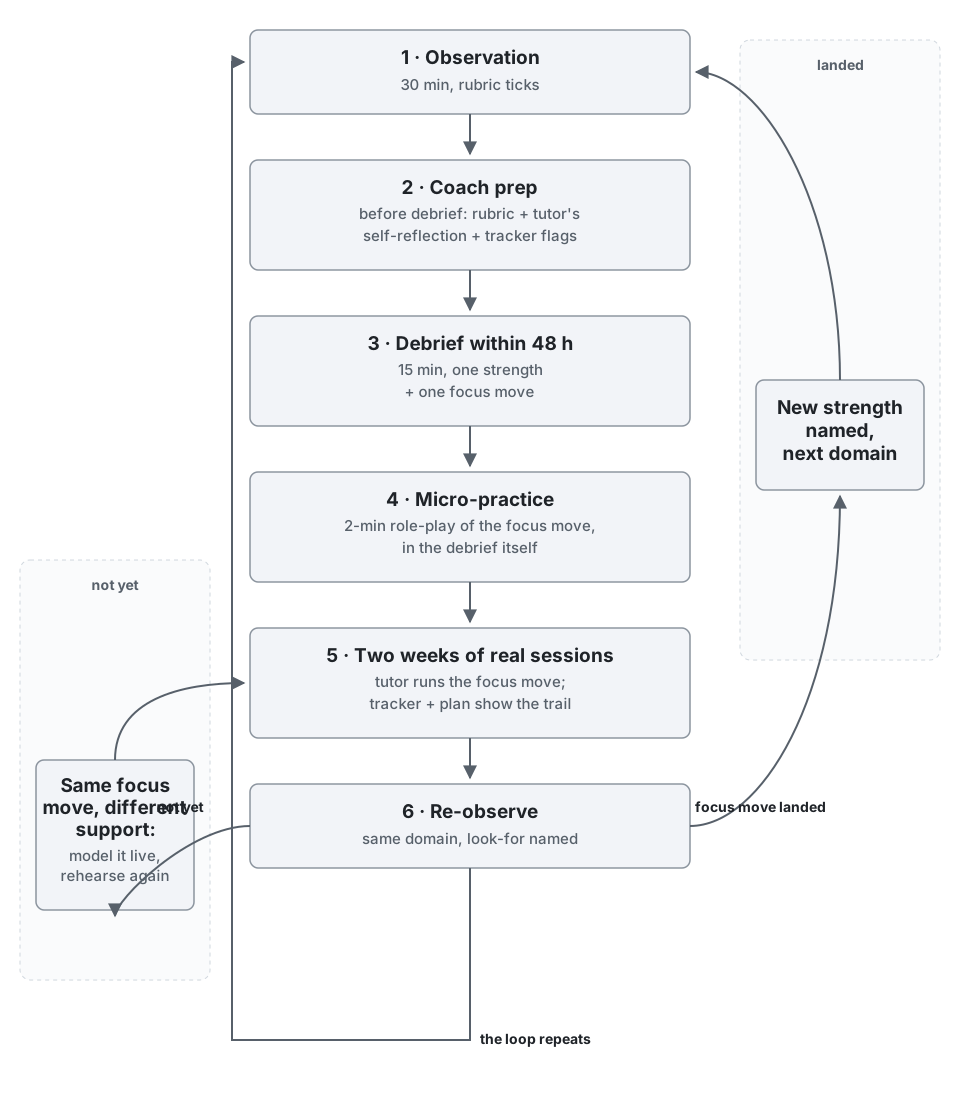
The diagram’s editable source (Mermaid — GitHub Pages does not render it, so the SVG above is the published rendering; regenerate the SVG from this source if the cycle changes):
flowchart TD
    A[Observation<br/>30 min, rubric ticks] --> B[Coach prep<br/>before debrief: rubric + tutor's<br/>self-reflection + tracker flags]
    B --> C[Debrief within 48 h<br/>15 min, one strength + one focus move]
    C --> D[Micro-practice<br/>2-min role-play of the focus move,<br/>in the debrief itself]
    D --> E[Two weeks of real sessions<br/>tutor runs the focus move;<br/>tracker + plan show the trail]
    E --> F[Re-observe<br/>same domain, look-for named]
    F -->|focus move landed| G[New strength named, next domain]
    F -->|not yet| H[Same focus move, different support:<br/>model it live, rehearse again]
    H --> E
    G --> A
Text description of the diagram (for screen readers and print): the cycle is a loop of six steps. (1) The coach observes a 30-minute session, ticking behaviors on the rubric print sheet. (2) Before the debrief, the coach reads the rubric notes, the tutor’s self-reflection and any tracker flags. (3) Within 48 hours, a 15-minute debrief lands one strength (with evidence) and one focus move — never a list. (4) The focus move is micro-practiced in the debrief itself: a two-minute role-play, coach playing a student. (5) Over the following two weeks the tutor runs the focus move in real sessions, leaving a trail in their plans and tracker. (6) The next observation re-looks at the same domain with the look-for named. If the move landed, the coach names a new strength and picks the next domain; if not, the same focus move returns with different support — modeled live, rehearsed again. Then the loop repeats.
Why the cycle is shaped this way
- Within 48 hours — feedback decays fast, and so does the tutor’s memory of the moment the focus move should have happened. A debrief a week later is archaeology.
- One focus move, not five — the rubric produces five domains; the cycle deliberately takes one. Concentrating on a single move is what makes the next observation a re-check rather than a fresh trial, and it matches how the fictional program scores growth (observation 1 → observation 3, target +0.5 average in the measurement plan).
- Micro-practice inside the debrief — the same logic as live practice sessions: a move not rehearsed is a move not done. Two minutes of role-play (“I’m Desi, I wrote 2x − 4 — go”) surfaces the exact wording trouble before the tutor meets a real student with it.
- The look-for is named at re-observation — the tutor knows precisely what the next observation will watch for. Surprise observations measure anxiety, not skill.
Choosing the focus move (the 2-minute rule)
From the rubric sheet, pick the focus by taking the lowest domain, lowest-stable — with three overrides:
- Data-loop first (Domain 5 ≤ 2): if the exit-ticket loop is broken, it outranks everything — no data means no other coaching conversation can show effect. Module 5 is the fix.
- One mistake away (Domain 3 at 2): a tutor at “corrects errors outright” is often one probing-question stem away from 3 — highest leverage per week of practice. Module 3 + Session B materials.
- Relationships can’t be the first focus if the tutor is new and struggling with structure — name the warmth as a strength (it usually is), focus on structure, and let the relationship behaviors consolidate. New tutors can’t work on five fronts, and T5 shows warmth surviving every other failure.
Scheduling inside the fictional program
| Coach load | Cycle cadence | Where it appears |
|---|---|---|
| 1 coordinator : 10 tutors | Observation + debrief = 1 hour per tutor per 2–3 weeks ≈ 4–5 hours/week | onboarding timeline weeks 3+; monthly community-of-practice reviews cycle themes |
| Observation #1 (week 3), #2 (week 6), #3 (week 9) | Growth measured 1 → 3 | measurement plan tutor-development row |
Fictional program, real cadence. The numbers above are the fictional Bridge Math Tutoring’s design, but the discipline — 30 minutes, within 48 hours, one move, re-observe — is the transferable content. The conversation guide carries the words; this page carries the clock.